Religious Sights in Avignon — 5 of Our Favourites

Discover and book the top Avignon sights

a grand palace in Avignon

1. Petit Palais museum

Location
Avignon

The Petit Palais museum owes its name to the familiar name of the Archbishops Palace in which it is installed, name that it was given by reference to the great neighbouring palace: the Palais des Papes.

The museum houses a number of permanent collections of Italian painters, local sculptors and painters from the school of Avignon, as well as a number of temporary collections and exhibitions.

There is a tea room on site, you can enjoy a snack and a rink in the courtyard, which is open from 10:00 - 18:00 except Tuesdays.

Admission price:

6 euros or 3 euros per person in a group of 10.

photo of a historic building

2. Palais des Papes

Location
Avignon

This magnificent building was built for Pope Benedict III in 1335 as a residence and a 'grand project'. It's the largest Gothic palace in the world (at 15,000 square metres) and is in the top ten most visited monuments in France (over 650,000 visitors per year).

During the first twenty years of construction, the 'Tower of Angels' and the Great Chapel were built along with a cloister and two stout towers for defence purposes.

Pope Clement VI added more towers, the Great Audience Hall and the Honour Courtyard ten years later. The palace is full of frescoes, hidden staircases, terraces, apartments and chapels.

The Palais des Papes hosts many cultural events throughout the year.

photo of a cathedral

3. Cathedral Notre Dame des Doms

Location
Avignon

With the arrival of French pope Clement V, Avignon was transformed into a religious and artistic centre. The grand Notre Dame cathedral has existed since the twelfth century, but the current building has been subjected to a number of alterations. The eye-catching gold statue of the Virgin Lady on the top of the tower is six metres in height and weighs 4,500 pounds.

The name of this cathedral "Notre-Dame des Doms" comes from the latin Domus episcopali meaning "from the Bishop's house". Historians tend to believe that from the 4th century onward there was here a basilica and close to it the bishop's residence. Destroyed by the Saracens in 731, it was rebuilt and consecrated on October 8, 1111.

In recent years, the cathedral, which belongs to the French state like all existing churches built prior to 1905, has been restored and enhanced in more than one way. For example the carillon now includes 35 bells ringing liturgical melodies all year long.

The cathedral also holds two organs :

  • On the one hand the Italianate gilded organ in the gallery was built by Lodovico Piantanida from Lombardy. It was restored in 2005 by "Fabrica d'organi Mascioni" from Azzio (Province of Varese, Italy).
  • On the other hand, there is in the choir a 1902 organ by Cavaillé-Coll which was restored in 1954 by Puget of Toulouse, France.

In the chapel devoted to Jean XXII, you will find various priceless religious objects, reliquaries and vestments belonging to the diocese of Avignon.

Masses are held daily, early morning during the weeks at around 8:00am and at 10:00am on Sundays.

stone walls and a path leading to a fortress

4. Chartreuse du Val de Benediction, Villeneuve les Avignon

Location
Avignon

This Carthusian monastery heralds back to the 14th century when it was built for Pope Innocent VI. The monastery consisted of a church and three cloisters which made it the largest monastery in France.

During the Revolution, the monastery suffered terrible damage but it has since been lovingly restored. With monks cells, kitchen, a chapel and pretty gardens to see, you can wander around yourself or take a guided tour.

The Chartreuse is home to playwrights and artists who can lodge here for free for up to a year.

photo of a fort towers in Avignon

5. Fort St Andre & Abbaye St Andre, Villeneuve les Avignon

Location
Avignon

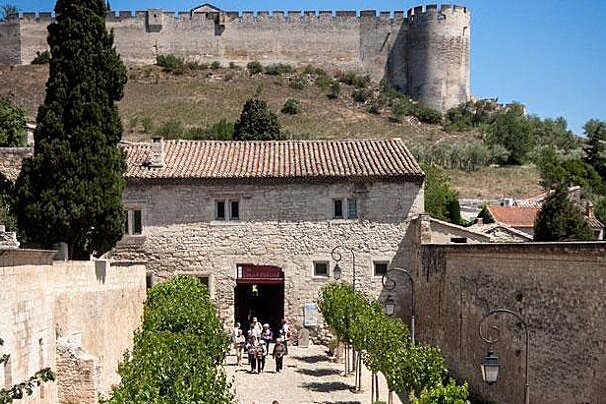
The 14th century Fort St Andre was built by order of the King of France, Philippe le Bel as a mean to keep an eye on the papal city of Avignon. Perched on a hill, this impressive structure contains the ruins of the Abbaye St Andre.

There are beautiful gardens inside the Abbey with terraces, rosebeds and a pergola. The views of the Rhone Valley and Avignon are spectacular. The Fort is open to the public throughout the year for a small fee.