
Sights in Nimes — 12 of Our Favourites

Discover and book the top Nimes sights

Planetarium, Nimes

1. Planetarium, Nimes

See the universe projected onto the roof of a large room filled with 65 comfortable seats, and wonder at the scale of it all.

There are different shows aimed at adults or children and on weekends from 15:00 they have a themed monthly show:

  • January: The performances of the sky
  • February: Travel in the Solar System
  • March: Diving in the spring sky
  • April: The Mysteries of Mars
  • May: Life and death of stars
  • June: The planet with a thousand eyes
  • July: Stroll in the summer sky
  • August: The Hubble Space Telescope
  • September: The evolution of instruments and the autumn sky
  • October: A named star sun
  • November: planetary debris and collisions
  • December: The wonders of the winter sky

The Planetarium is closed on Mondays and public holidays.

a courtyard and old building in nimes

2. Musee Archeologique, Nimes

Objects from local and regional sources, with the exception of a fund of Greek ceramics, Etruscan, Italiot, derived from bequests from private collections and a deposit of the State (Campana).

The first museum of Nîmes was created in 1823 in the Maison Carree. At the end of the nineteenth century, the city decided to install lapidary archaeological collections in part of the former Jesuit college located south of the old city, between the High Street and Boulevard Amiral Courbet

The inauguration took place in 1896. In 2018, the collections of the Archaeological Museum will be presented in the future Museum of Romanité, opposite the Bullring.

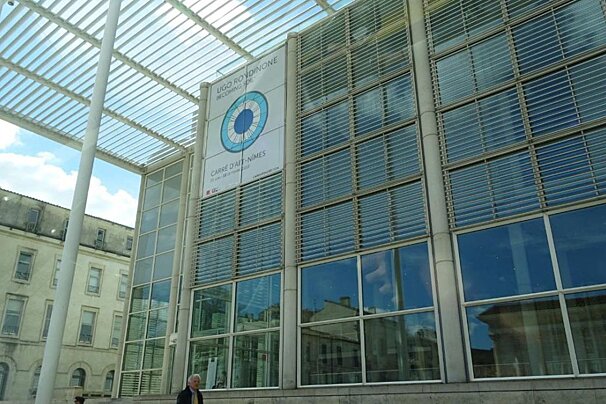
Carre d'Art Museum, Nimes

3. Carre d'Art Museum, Nimes

Not only is this modern building home to the museum of contemporary art, but it also houses Nimes central library.

It faces the famous Maison Carré which you can enjoy a great view of from the coffee shop on site.

Started in 1986 with substantial State backing, the contemporary art museum’s collection includes nearly 480 items spanning from 1960 to the present day.

You'll find works by Mario Merz, Giuseppe Penone, Alighiero Boetti and Giovanni Anselmo. Also included are major works by American artists like Richard Artschwager, Allan Kaprow, Joseph Kosuth and Christopher Wool. Part of the collection is devoted to German painting, with works by Gerhard Richter, Sigmar Polke and Albert Oehlen and installations by Thomas Schütte.

Walid Raad, Ryan Gander, Philippe Parreno and Taryn Simon are among recent acquisitions and loans.

The museum is home to permanent collections and also temporary exhibits and events throughout the year.

Les Arenes, Nimes

4. Les Arenes, Nimes

The Nimes Roman Arena is an amphitheatre that dates back to the end of the first century AD. It is an impressive sight, with two levels of 60 superposed arches.

This Roman amphitheatre used to seat 24,000 spectators. In Roman times the Arena was used for spectator games, where gladiators would fight each other or against bulls, bears or wild boars (the exotic animals were reserved for the arenas in Rome), where chariots would sweep around the sharp bends, and the orchestra accompanied the confrontations to heighten the excitement.

Today, the same arena (now seating 7000) is still used for spectator sports-confrontations, this time between bull and matador, with the highlights during the Ferias (fairs) season. Then the young bulls run through the town chased by amateurs, equally inexperienced as the bulls themselves, one would hope. It is a big event, taking place in spring and September, during the grape-harvest season. The bullfights as well as the Ferias are world famous, with crowded streets and tickets hard to come by.

Regular events take place through the summer, take a look at our events calendar to see what's going on.

Nimes Arena is open every day (except for fairs and shows).

  • January, February, November and December: 09:30 - 17:00
  • March and October: 09:00 - 18:00
  • April, May and September: 09:00 - 18:30
  • June: 09:00 - 19:00
  • July and August 09:00 - 20:00

A visit to the Arena on its own is 10 euros with an audioguide, or 8 euros for concessions, or you can buy a 'Pass Nimes' for the Arena, Maison Carre and the Tour Magne for 12 euros.

Maison Carree, Nimes

5. Maison Carree, Nimes

A very well preserved Roman temple in the heart of Nimes.

It acted as the economic and administrative centre of ancient Nimes when the area was in Roman hands. The building is inspired by the temples of Apollo and Mars Ultor in Rome. It has been in continuous use since the 11th century and is now a museum where visitors can watch a 3D film about its history.

The building is open every day and on the following dates / times.

  • January, February, November and December: 10:00 - 13:00 / 14:00 - 16:30.
  • March and October: 10:00 - 18:00 (closed from 13:00 to 14:00 in October)
  • April, May and September: 10:00 - 18:30
  • June : 10:00 - 19:00
  • July and August: 09:30 - 20:00
Cathedrale Notre Dame et St-Castor, Nimes

6. Cathedrale Notre Dame et St-Castor, Nimes

This large cathedral was originally built in 1096 and has undergone many additions and modifications over the centuries.

It's very imposing from the outside with a Romanesque style frieze on the upper stories, which is said to be one of the best examples known in southern France.

It sill functions as a working church to this day with regular services, and you can still visit and take a look around inside.

Apparently acanthus and lion head motifs on the pediment and the cornice were inspired by the Maison Carrée.

a Roman tower in a park

7. Tour Magne, Nimes

The Tour Magne, or the Great Tower, is the only remnant of the ancient Augustan fortifications of Nimes.

Standing at the highest point of the city, Mont Cavalier, it overlooks the entire plain and is a focal point for all means of communication. The tower was originally a dry-stone oval tower, with a maximum height of 18m and already part of a rampart.

A structure that was both prestigious and strategic, it represented sanctuary and protected the oppidum.By doubling its height and incorporating it into the town walls, Augustus demonstrated the new power of the colony of Nîmes over the “City” (in the territorial sense) of the Volcae. When the town’s population abandoned the higher ground, the Tour Magne nevertheless continued to play a military role. It was used to defend against the English during the Hundred Years’ War.

Enjoy the panoramic views as you look down over Nimes.

A visit to tower costs €3.50 or you can buy a 'Pass Nimes' to visit the Tour Magne, the Arena and Maison Carré for 12 euros.

Jardin de la Fontaine, Nimes

8. Jardin de la Fontaine, Nimes

Noted to be the first European public garden, it consists of two landscaped areas: a classic garden of the seventeenth century and a Mediterranean garden landscape style.

The garden itself was started in 1745 at the request of Louis XV, the then King of France. Since then, many spaces have been created to enrich the area, such as the rock garden, mix of rocks and Mediterranean plants, the Montgolfier pool with aquatic plants, Mazet garden.

The Temple of Diana, Nimes

9. The Temple of Diana, Nimes

This Roman monument may not have the grandure and scale of some of the other Roman buildings in Nimes, but is interesting and worth a visit nonetheless.

No-one is quite sure of its original use nor the reason it came by its name.

Today it is partly ruined although you can see columns, corridors, vaults and niches which may have been used to display statues.

A fire is believed to have destroyed it around 1600.

You'll find it alongside the Jardins de la Fontaine and it's free to visit.

image of a river

10. Gorges du Gardon

The Gardon Gorge is a nature reserve that runs between Nimes and Uzes for 20km. The Gardon river has been forging its way through the limestone rocks to create a deep canyon that is home to a wide array of wildlife and vegetation.

There are a number of walking trails through the gorge and the surrounding plateaux. A popular walk visits the cave of Saint Baume - torch recommended! You can also take a canoe down the river, and there are rock climbing routes and a Via Ferrata. Mountain biking is also allowed (but quite tricky routes) and of course, you can cool yourself off with a swim in one of the bathing areas of the river.

Musee des Beaux Arts, Nimes

11. Musee des Beaux Arts, Nimes

This museum was founded in 1821 and the collection was originally housed in the Maison Carree, moving to its current location in 1907.

Private collections made up of many Roman period pieces started the original museum collection, which has now been added to with a number of old masters paintings and works by amateur artists.

The museum is now home to a little under 4000 works of art including pieces by 15th, 16th and 17th century artists - with Rubens and Paul Delaroche amongst them.

The permanent collection is free to visit although expect to pay 3 euros to visit one of their temporary exhibitions.

Le Castellum Aquae, Nimes

12. Le Castellum Aquae, Nimes

This unusual Roman site was once the place where the city of Nimes supply of water arrived from the aqueducts before being distributed around the city.

Lead pipes would have taken the water to the various fountains and baths of the city for its inhabitants to enjoy, through the round apertures that you can see in the structure.

It is thought to have been constructed in the middle of the first century AD, at the same time as the Pont du Gard. Water would have travelled around 50 kilometres to get here, over the Pont du Gard and into the city. A sluice gate at the back would have controlled the flow of water.

During the construction of the citadel in 1688 the Castellum was filled in with rubble, and only rediscovered in 1844 when it was excavated and made visible to the public once more.

Today it's a rather small an unassuming relic of the Roman period, compared to some of the larger more well known Roman ruins in Nimes, but interesting to see nonetheless.