Nature / Park Sights in Provence — 17 of Our Favourites

Discover and book the top Provence sights

a photo of a mountain

1. Mont Ventoux

The highest point in Provence at 1,912m, Mont Ventoux is most famous as the killer-climb stage in the Tour de France. It's a mecca for cyclists and hikers, with three routes available for cyclists and a number of trails for walkers.

The main thing to watch out for is the wind - the Mistral comes running south from the Alps and can reach speeds of up to 300km/h. The one benefit of this wind is that it makes the air incredibly clear which is ideal for artists and helps explain why so many of them came to stay in Provence.

The white limestone summit makes it look as if Mont Ventoux is snow-covered all year round (in fact there is a small ski resort on the northern face). There is a wonderful array of wildlife and vegetation and the lower slopes form the Reserve de Biosphere du Mont Ventoux.

Reserve des Mont d'Azur

2. Reserve des Mont d'Azur

Come and see bison, deer, horses, boars and hawks roaming on 700 hectares of land, just one hour from the French Riviera

A large animal reserve where over 500 native European breeds can be seen in their natural surroundings.

Enjoy guided walking safari tours, horse drawn wagon rides, or even see the animals at dawn and dusk on an overnight stay in the reserve's on-site accommodation. The reserve also carries out important ecological work with rare species, which you can learn more about at the centre.

Open to the public from 1 March to the first weekend of January. To respect the high ecological standards established by the scientific team, the number of daily visitors is limited and guided visits are preferably booked in advance. Guided safaris start at around 20€, with discount prices for teenagers and children.

Mont Sainte-Victoire

3. Mont Sainte Victoire

Location
Aix-en-Provence

This pyramidal peak features in over 60 of Paul Cezannes paintings. The light and the colours are a dream for artists, and non-artists can also enjoy the scenery via the lattice of walking trails that cross the mountain slopes.

Picasso is burried on the northern slopes of the mountain, in the grounds of Chateau de Vauvenargues. This privately owned castle is closed to the public.

This area is very popular with walkers, hikers, bikers and climbers. You will encounter many small paths and caves on your explorations of the area. Plus several small chapels hidden in the rocky hillside.

Cascade de Courmes, Gorges du Loup

4. Gorges du Loup, Cannes Region

The narrow and beautiful Gorges du Loup cuts north-south through the hills at the foot of Gourdon, 12 km from Grasse.

About 4 km up the deep gorges, the Cascade de Courmes (waterfall) comes down over the rocks and then spills over large mossy boulders into the pool, 40m below the top. A spectacular sight!

a mountain range in provence

5. Parc Naturel Regional des Alpilles

Location
Les Baux-de-Provence

This large natural area envelops 16 small towns and villages between the Luberon and the Camargue, not far from Arles.

The white limestone rocks in the park stand out against the brilliant blue of the sky and vineyards and olive groves take advantage of the best-oriented hillsides. It is a living area of exceptional beauty. Home to author Alphonse Daudet, distances are short here and there is always a delightful destination for a walk, a cycle ride or even a trek on horseback.

The Park has been successful in focusing on the relations between Man and his environment, whether the term is taken in the sense of nature or heritage, or refers to economic and social environment.

Despite the current popularity of the Alpilles and the influx of tourists, history buffs and nature lovers, this part of Provence has not changed its everyday way of life and it has retained the strong values that give it its identity. Traditional festivals take place in the villages of Alpilles all through the year, often still linked to the agricultural calendar - celebrating the seasons and crops.

With its varied environments, flora and fauna and rare species, the Park is certainly of scientific interest. However, nature in the Alpilles is much more than that. Fashioned by its people over hundreds of years, it boasts an inherited culture that gives the mountain range much of its uniqueness.

The park has been designated a protected area since 2007 when it became the 5th regional parc in the PACA zone.

a photo of red cliffs

6. Massif des Ochres du Luberon

A seam of red, yellow & orange rocks runs through a small part of the Luberon, from Roussillon to Rustrel.

The rocks were formed millions of years ago when Provence was under the sea, and the iron-based minerals in the sands are responsible for the red tones. These minerals have mined by humans since ancient times and have been used as a pigment called ochre by many cultures.

In the Luberon, there are a number of sites where you can explore the rocks and the landscapes that have been produced by the mining processes used through time. In Roussillon itself, there is an Ochre Trail that takes you through an old quarry on a 30 or 60 minute walk.

Also in Roussillon is the Conservatoire des Ocres where youcan discover how ochre is mined and extracted.

In Gargas, there is the Mines de Bruoux - an old mine consisting of 40km of underground tunnels, of which 650m are open to the public. Or stay above ground and visit the Colorado de Rustrel near Apt, which is another old quarry with trails, picnic areas and gift shop.

a walk way on an island along the river

7. Ile de la Barthelasse

Location
Avignon

The perfect setting for a Sunday walk or a family bike ride is just a short ferry trip away from the city centre of Avignon on the Ile de la Barthelasse.

The Barthelasse island lays between two river arms and is spread over 700 hectares. Being riddled with little roads and paths makes this a very pleasant place to walk, run or bike around.

"When Avignon's medieval popes needed a break from the hubbub of their walled city, they crossed a bridge to this island in the middle of the Rhone River. Centuries later, Ile de la Barthelasse and adjoining Ile de Piot--whose vineyards, vegetable gardens, and pear, apple, and cherry orchards cover more than half of their nearly three total square miles--still make for a wonderful getaway."

There are also plenty watersports available around the island with kayaking, jet skiing and swimming.

people walking into a canyon in france

8. Gorges de la Meouge

The Méaouge canyon is classed as a biological reserve thanks to its diverse flora and fauna, some of which come from as far away as north Africa and Iberia.

There are a multitude of walking trails around the canyon and its also renowned as a great place to come for a swim.

There is a well preserved Roman bridge with three arches still standing and next to it is a popular swimming spot. In spring time you're allowed to kayak down the river too. Paragliding and hang-gliding are also popular here, thanks to the dramatic views on offer.

a river in north provence

9. Gorges du Toulourenc

This river gorge runs for around 30 kilometres from the small village of Saint Leger, heading west along the borders of the Vaucluse and Drome regions.

You can enjoy a walk along the river, taking a dip in the cool waters of some of the pools along its route.

In some places water crossings (you'll get wet) are unavoidable, but there are the odd few small beaches you come across, or you can hop across the stones.

As you progress down the gorge, the walls become steep and more enclosing. At the far end there is a trail that takes you up to a view point looking down over the gorge from above. From here you can follow the small road back to the village and your start point.

Geoparc de Haute Provence

10. Geoparc de Haute Provence, Digne les Bains

This unique natural area was designated as a 'Geoparc', the first of its kind, by UNESCO in 2000 and has since become the model for the development of Geoparks across the world.

A region where the memory of the Earth meets the memory of Mankind, it unites the blue water shores of Lake St. Croix with the snowy peaks of Dormillouse and includes a unique diversity of landscapes where Alpine and Provençal features intertwine.

Geology: The Geopark is enriched by the presence of a "Memory of the Earth", inviting us to take a journey through time, discovering the last 300 million years of the history of our planet. A journey that, far from being limited to the search of our origins, allows us to provide a fresh outlook onto today's landscapes, whose slow transformation is understood through the analysis of remarkable sites: the ammonite slab, ichthyosaurs, fossil bird footprints and more.

Nature: The whole area is characterised by a remarkable ecological richness with an extreme biodiversity.

Cultural heritage: In the same way as the evolution of Earth left behind the the testimonies of its transformations throughout the Geopark, human presence has left behind its cultural footprints too. Each chapter of this story can be read in the territory and practically every town has its historic monument. Whether through religious, civil or military architecture, the ancestral relationship between its inhabitants and the planet can be seen here.

Contemporary art: With the CAIRN Art Centre and the Gassendi Museum, the Geopark has become a privileged and unique place during the last 20 years, where contemporary art converges with the landscape. Today, its territory has a huge collection of over 100 works of art produced in the natural environment by a group of renowned artists, like Andy Goldswerthy and his "refuges d'Art", Richard Nonas, or Herman de Vries. Thanks to these works created through CAIRN initiatives, the UNESCO Geopark is an innovative territory : the visions of these artists invite visitors to continually discover and rediscover landscapes. The CAIRN Art Centre is located in the Musée Promenade.

Discover the map of all the contemporary art sites and amenities present in the Geopark region.

The whole area covers 1,989km², with over 80 different sights and attractions available to see and visit.

image of a river

11. Gorges du Gardon

The Gardon Gorge is a nature reserve that runs between Nimes and Uzes for 20km. The Gardon river has been forging its way through the limestone rocks to create a deep canyon that is home to a wide array of wildlife and vegetation.

There are a number of walking trails through the gorge and the surrounding plateaux. A popular walk visits the cave of Saint Baume - torch recommended! You can also take a canoe down the river, and there are rock climbing routes and a Via Ferrata. Mountain biking is also allowed (but quite tricky routes) and of course, you can cool yourself off with a swim in one of the bathing areas of the river.

Gorges du Verdon, Provence

12. Gorges du Verdon

The French Grand Canyon, the Grand Canyon of Verdon, the Gorges du Verdon, by whatever name this natural phenomenon is referred to it will remain to the beholder as one of the most spectacular sites in Europe.

Not as "Grand" as its namesake in Arizona, this canyon is accessible, still wild, dramatic in its colour schemes, inviting to active hikers or wild-water rafters, canoeists or rappellers. But motorists will equally be awed by the numerous vistas along the roads to the south or north of the canyon.

For ages the Verdon river has sliced through the limestone mountains, at a lesser force nowadays than tens of thousands of years ago. The steep crevice with a drop of 800m runs from Castellane to end in the man-made Lac Ste Croix to the west, in between the department of the Var and that of the Alpes-de-Haute-Provence (see map), a route of 21km.

By car, you can follow two routes:
D952 along the north bank (Rive Droite or sometimes indicated as Rive Nord).
D71 one along the south bank (Rive Gauche), as if we're in Paris.

In general, the southern route is considered to be the one with the best views, but the northern route has the spectacular loop of the Route de Crêtes where you find the most vertical cliffs and daredevils without a hint of vertigo. The northern route also gives you the opportunity to buy the best bread in France, if not the world, just before Rougon (when driving from the east). A sign will point out an outdoor café, a baker and a watermill that accounts for the local flour. There's just one kind of bread, in one large size (can be cut in half).

No matter which route you choose, you may be tempted to view this canyon from a lower point. Until the end of the 19th century the canyon itself had never been explored, not even by local people. It was considered highly dangerous, inaccessible, either to descend to or access by the Verdon wild waters from an earlier point. Finally, in 1905 a trio of explorers attempted to follow the river with sailboats (rafting was not known in those days) and encountered many disasters. The next year they tried again and were more successful, managing to do the 21km stretch in three days.

Today the active, fit and experienced person can explore the canyon other than by car. There are marked hiking trails, wild-water rafting tours, rappelling or paragliding clubs. For more contacts look at the end of this page.

At the end of your trip (assuming you take the preferred east-west route) you will arrive at Lac de Ste. Croix, a huge man-made lake created by EDF (France's Electricity Co.). From there you can spend your time on the beach, swim in the soft water of the lake (bring plastic sandals, because the bottom is very muddy and rocky), rent a roundabout with electric outboard (no diesel or gasoline engines allowed), canoes, kayaks or pedal boats.

From the lake you enter the calmer end of the canyon, admire the waterfalls, the dramatic crevices in the limestone rocks, the occasional divers à la Acapulco from the top of the cliffs.

Please note, hiking in the Gorges is not for the casual walker. One has to be fit, equipped with good hiking boots, a (working!) flashlight, and plenty of water. Every year there are serious accidents, some fatal, on the hiking trails in the Gorges du Verdon.

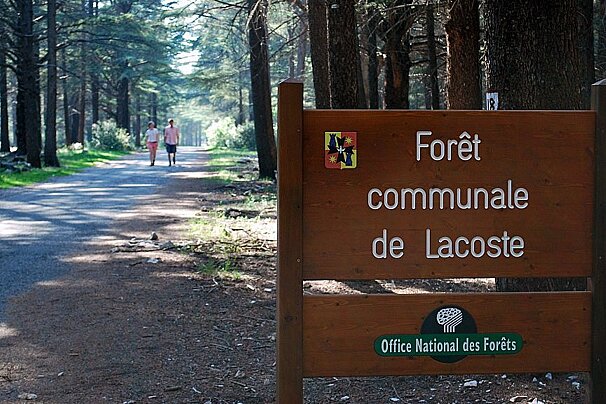
a forest sign & path behind

13. Foret des Cedres, Lacoste

Originally from the high mountains of North Africa,these particular cedar trees were introduced in to France as an ornamental tree and as a method of reforestation.

In around 1861 they were planted and thrived on limestone mountains of the Luberon. Lacoste cedar forest is now thought to be one of the most beautiful in Europe. At present, the cedar forest form a mass of about 250 hectares, divided between the towns of Bonnieux, Lacoste and Menerbes.

There are also now many rare and protected plant species in the forest. The presence of the cedars for over a century now has greatly improved the quality of the soil and the density of the foliage, allowing the growth of a variety of shrubs below.

The forest is a popular place for hiking and cycling as there are many paths and Discovery Trail throughout. There are ten panels of information on the many Luberon plant species that will guide you through your walk. You can discover the lookout Portalas, which offers an xceptional view of the south side with the Durance valley, the Alpilles and the Sainte-Victoire.

Plaine des Maures, Natrural Park

14. Plaine des Maures Natural Park

Location
Saint Tropez

La Plaine des Maures is the first natural park in the Var department, to the north west of Saint Tropez. It is renowned for it's umbrella pines and cork oak trees, and is rich in fauna and flora.

Forming a geographical entity with the Massif des Maures, it is bordered by limestone hills in the north and west. This magnificent landscape is often compared to the African savannah and is unique in France. Parasol pines amid pink sandstone outcrops and sparse cork oak scrubland are set against the blue background of the Massif des Maures. The unusual Permian geomorphology and climatic conditions within the Plaine des Maures have formed a unique collection of ecosystems which are home to a rich array of fauna and flora.

La Plaine des Maures is home to many Hermann's tortoises and is subject of a national action plan to preserve their natural habitat.

There are several trails available for hikers, mountain bikers and horse riders. 

Note that these trails are not overly managed so may be a little rocky or sparse in places. Sign posts are placed at the main junctions. Some trails you may like to explore include:

  • Les Vallons des Escarcets: a hike of 6.2km
  • La Dernière Plaine Sauvage: a hike of 13.1km
  • Les Drailles des Escarcets: a mountain bike trail of 14.2km
  • La Ronde des Escarcets: horse ride 17.8km
Gorges de la Nesque, Sault

15. Gorges de la Nesque

The gorges de la Nesque is an impressive and wild canyon of around 12 kilometres in length, scoured out by the river at its bottom.

The richness and diversity of its flora and fauna led UNESCO to classify the gorge as a Biosphere Reserve to protect the area and everything that lives within it.

Various view points along its length offer you views of the imposing cliffs and stunning scenery below, or you can admire the view from the walking trails or the road that winds its way along the route of the river.

At the bottom of one part of the gorge is a small chapel, nestled under an overhang in the rock which can be accessed on foot. Prehistoric rock shelters can also be found in a couple of places.

an image of a village and the green hilly countryside

16. Parc Naturel Regional du Luberon

The Luberon park covers the area from Cavallion in the west to Manosque in the east.

As it's a regional park, it encompasses all the towns, villages and countryside and it's main role is to supervise development to ensure the natural environment is protected.

During the summer, plenty of outdoor activities are available - hiking (1,000km of marked trails), mountain biking, horse riding, climbing, ballooning and paragliding.

Guided tours are available in the summer - head to the local tourist office to sign up.

an aerial shot of Lac de Saint-Cassien

17. Lac de Saint-Cassien Nature Park

Situated in the Fayence area of the Var, not far from the south coast of France, this lake offers a welcome respite in the heat of the summer months.

Originally intended for the production of hydroelectric energy, the lake has become a much-appreciated spot for enjoying leisure activities. Yet, it still remains ecologically important and visitors are asked to keep this in mind and to respect not only the site but also its flora and fauna. It is home to more than 180 species of birds and the European pond turtle.

This large, deep lake is surrounded by forest and rolling hills, and there are a multitude of coves, little beaches, and perfect picnic spots all around the edge. During summer there’s often an inflatable waterpark set up right in the middle of the lake, and there are pedallos with waterslides and kayaks for hire. Shallow and warm at the edges, the lake does get deep and cold in the middle: the perfect refresher on a hot summer day.